交通
🚆 Getting Around Tokyo

Trains, Metro
& Airports

— täsmällinen, puhdas ja uskomattoman kattava. Tältä sivulta löydät kaiken tarvitsemasi lentokentältä kaupunkiin ja siellä liikkumiseen. Tokyo has the world's best public transport — punctual, clean and incredibly comprehensive. This page covers everything from airports to the city and navigating within it.

🗺 Train Map ✈ Narita → City ✈ Haneda → City 💳 IC Card 🎫 JR Pass 💡 Pro Tips

Tokyo Train Map

Tokyo has over 300 train stations and several separate networks: JR (national railways), Tokyo Metro, Toei subway and private lines. The Yamanote Line loops around the city centre — it's your most important route. Both Narita and Haneda airports connect directly to this network.
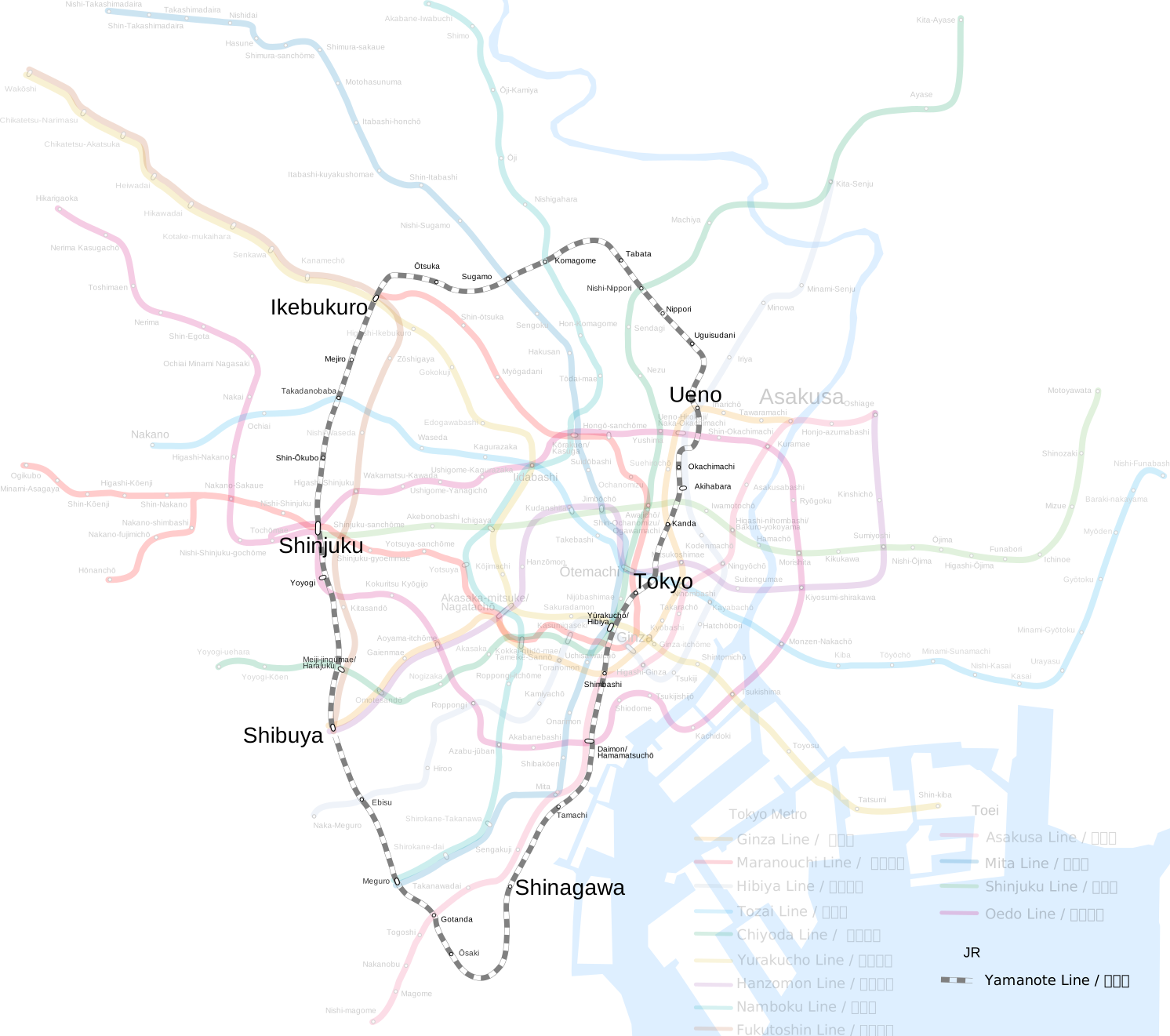
Tokyo train & metro route map — Yamanote, JR lines and all subway lines
✈ NARITA — N'EX 53 min / Skyliner 36 min
✈ HANEDA — Keikyu 15 min / Monorail 20 min
Yamanote (JR)
Marunouchi
Ginza
Tozai
Hibiya
Map © Wikimedia Commons CC BY-SA
🗺 Interactive map — zoom and search routes Open full screen →
💡 Logic of Tokyo Transit
Tokyo operates three separate networks: JR trains (green signage, use Suica), Tokyo Metro (blue M logo) and Toei subway (orange). An IC card works on all of them with no separate ticket needed. Transfers between lines are clearly signed in English.

Narita to the City

Narita is 60 km northeast of Tokyo — the journey takes one hour or more. You have four main options: N'EX train, Keisei Skyliner, Access Express or limousine bus. All depart directly from the terminal.

BEST CHOICE
Keisei Skyliner
36
min → Ueno
¥2,520
adult
Fastest route to Ueno and the Yamanote Line. Guaranteed seat, space for luggage. Book online in advance to save a few yen.
FAST JR
N'EX (Narita Express)
53
min → Shinjuku
¥3,070
adult
JR Pass is valid here! Goes directly to Shinjuku, Shibuya and Yokohama. Best if you're staying near Shinjuku or Shibuya. Free for JR Pass holders.
CHEAPEST
Keisei Access Express
59
min → Ueno
¥1,340
adult
Cheapest train option. May be standing room only at busy times. Also stops at Asakusa and Oshiage without transfer. Works directly with Suica.
BUS
Limousine Bus
90–120
min
¥3,200
adult
Goes directly to major hotels. Convenient if you have lots of luggage. Can take 2+ hours in traffic. Buy tickets at the limousine bus counter in the terminal.

📍 Step by step: Narita → Tokyo (Keisei Skyliner)

Step 1
Exit arrivals
Follow signs for Arrivals → passport control → customs. Use eGates if available — these are quick.
Step 2
Find Keisei station
After customs, follow "Keisei Line" or "Skyliner" signs down the escalator or lift. The station is under the terminal, a few minutes' walk.
Step 3
Buy your ticket
Use the Skyliner ticket machines or counter at the station. Select Skyliner → Ueno, ¥2,520. Also buy a Suica card here (valid for everything later). Combined Skyliner + Metro tickets available.
Step 4
Board the train
Check the platform number on your ticket. Skyliner departs roughly every 40 minutes. Your seat is assigned — find your carriage number on the ticket.
Step 5
Ueno station
At Ueno, you can transfer directly to the Yamanote Line. Continue to Shinjuku (~25 min) or anywhere on the loop. Tap your Suica card at the gates.
Step 6
At your destination
Tap your Suica card at the exit gate at every station. The system automatically deducts the correct fare. Hotels are usually within a few hundred metres of a station.
Transport Destination Duration Price JR Pass?
Keisei Skyliner Ueno 36 min ¥2,520
N'EX (Narita Express) Shinjuku / Shibuya 53–80 min ¥3,070 ✓ Valid
Keisei Access Express Ueno / Asakusa 59–68 min ¥1,340
Limousine Bus Hotels 90–120 min ¥3,200
Taksi / Taxi Anywhere 60–90 min ¥20,000–30,000
⚠ Avoid taxis from Narita!
A taxi from Narita to central Tokyo costs ¥20,000–30,000 (around €130–200). It's not included in any pass and is no faster in traffic. The train is always the better choice.

Haneda to the City

Haneda is only 14 km south of central Tokyo — much closer than Narita. The journey takes 15–25 minutes and prices are significantly cheaper. European carriers (including Finnair) increasingly fly to Haneda.

FASTEST & CHEAPEST
Keikyu Line
15
min → Shinagawa
¥300–440
adult
Fastest and cheapest option. From Shinagawa, transfer directly to the Yamanote Line. Works with Suica — no separate ticket needed.
SECOND FASTEST
Tokyo Monorail
20
min → Hamamatsucho
¥500
adult
Travels over the bay with spectacular views. Transfer to the Yamanote Line at Hamamatsucho. JR Pass is valid!
BUS
Limousine Bus
30–60
min
¥1,200
adult
Goes directly to many hotels and terminals. Good if you have lots of luggage. Can take an hour in traffic.

📍 Step by step: Haneda → Tokyo (Keikyu Line)

Step 1
International terminal
After passport control and customs, follow signs for "Railway" or "Keikyu". The station is on the 3rd floor of the international terminal.
Step 2
Tap or buy
If you have a Suica or Pasmo, just tap the gate. If not, buy a ticket from the machine — select Shinagawa (¥300) or your destination.
Step 3
Board Keikyu train
Keikyu departs several times per hour. Trains go directly to Shinagawa and on to Shinasaku, Sengakuji, etc. Transfer to the Yamanote Line at Shinagawa.
Step 4
Shinagawa → City
From Shinagawa on the Yamanote: Shinjuku ~25 min, Shibuya ~15 min, Tokyo ~18 min. Trains run every 3–5 minutes.
🌟 Why Haneda is better?
Haneda is far more convenient than Narita: cheaper journey, faster and closer. If offered flights to both airports at the same price, always choose Haneda.

Suica & Pasmo — essential purchase

An IC card is your most important travel companion in Tokyo. It works on trains, metros, buses, and also at shops, convenience stores and restaurants. Suica (JR) and Pasmo (Metro) work identically — get either one.

🛒 Where to buy?

From any JR station (including Narita and Haneda) ticket machines. Select "Suica" → "New Card". Costs ¥500 deposit plus the amount you load. You can also download the Suica app on iPhone/Android before your trip and use NFC payments.

💰 How much to load?

Load ¥3,000–5,000 to start. Rides cost ¥170–340 depending on distance. Top up anytime at station machines or via the app. Remember: cash is still king in many places in Japan.

📱 Apple Pay / Google Pay

Suica works directly on iPhone and Android via NFC. Add Suica to iPhone's Wallet app or Google Wallet. Load money directly from your phone with a European card. No physical card needed.

🚇 How to use

To enter: Tap your card or phone on the gate reader. The gate opens and the screen shows your balance. To exit: Tap the gate again. The correct fare is deducted automatically. If your balance is zero, the gate won't open.

🏪 Beyond transit

Suica works as payment at 7-Eleven, FamilyMart, Lawson convenience stores, McDonald's, many restaurants, vending machines and even some taxis. Very handy for small purchases.

💸 After your trip

Return the card at a JR service counter and get back the ¥500 deposit + remaining balance in cash. Or keep it for your next visit — it stays active for 10 years.

JR Pass — when is it worth it?

The JR Pass gives unlimited travel on all JR trains (including Shinkansen) across Japan. It's expensive, but if you travel a lot, it pays for itself.

7 days

~¥50,000
~330 € / person
  • Tokyo ↔ Osaka × 1 time (¥14,500)
  • N'EX Narita × 2 (¥6,140)
  • Tokyo ↔ Kyoto × 1 (¥13,600)
  • + need daily fares ~¥30,000

14 days

~¥80,000
~530 € / person
  • Recommended if travelling
  • Tokyo → Osaka → Kyoto → Hiroshima
  • + Shinkansen freely
  • Easily pays for itself

21 days

~¥100,000
~660 € / person
  • For touring all of Japan
  • Hokkaido ↔ Kyushu
  • Best for longer trips
  • Covers nearly all train travel
⚠ IMPORTANT: JR Pass must be purchased outside Japan!
You cannot buy a JR Pass after arriving in Japan (or prices are significantly higher). Buy it in advance from a travel agent, JR's official website or Klook. You receive a voucher to exchange for the pass in Japan.

📍 JR Pass: from purchase to activation

Step 1
Buy before departure
Order your JR Pass from the official site (jrpass.com) or Klook. You'll receive a voucher by post or digitally.
Step 2
Exchange at the airport
On arriving at Narita or Haneda, go to the JR East Travel Service Center. Show your passport and voucher. State which date you want activation to start.
Step 3
Use at the gates
The JR Pass doesn't work in normal electronic gates. Use the wide gate (separate wider barrier) or show the pass to the attendant. Don't be surprised — this is completely normal.
Step 4
Reserve seats in advance
For Shinkansen seats: reserve for free at JR service desks. Recommended especially during Golden Week and weekends. You can also sit in unreserved carriages.
🤔 Is JR Pass worth it for Tokyo only?
Generally not. If you're only staying in Tokyo, an IC card plus individual tickets works out cheaper. The JR Pass pays off when you're travelling between Tokyo and other cities (Kyoto, Osaka, Hiroshima, Hakone). Calculate your routes before buying.

Seasoned traveller tips

📱 Google Maps works perfectly

Google Maps transit directions are world-class in Tokyo. Enter an address, select transit — Maps tells you which train, which platform, when to leave and how many stops. Trust it completely.

⏰ Tokyo trains are punctual

Tokyo trains are punctual to the second. If the train leaves at 10:43, it leaves at 10:43:00. Delays are extremely rare. Trust the timetables completely.

🧳 Luggage on trains

Large suitcases don't fit well on crowded metros. Use Yamato courier service to send luggage to your hotel in advance (¥1,500–2,000). Available at Narita, Haneda and most hotels.

🚶 Walk when you can

Many Tokyo sights are 1–2 km walking distance from each other. Harajuku-Shibuya, Akihabara-Ueno, Ginza-Tsukiji — all walkable. Tokyo is surprisingly compact in the core neighbourhoods.

🌙 No night transport!

Tokyo's metro does not run at night. Last train around 00:00–01:00, first around 05:00. Stuck late in Shinjuku? A taxi costs ¥1,000–3,000 depending on distance, or night buses on certain routes.

💴 Carry cash

Japan is a cash society — many temples, small restaurants and markets only accept cash. Withdraw from 7-Eleven or Japan Post ATMs (international cards work). Bank ATMs outside supermarkets often don't accept foreign cards.
🗺 Useful apps to download

Google Maps — routes and transit

Suica / Pasmo — mobile IC card

Hyperdia — detailed train timetables

Google Translate — camera translation for signs and menus

Tabelog — restaurant guide used by locals