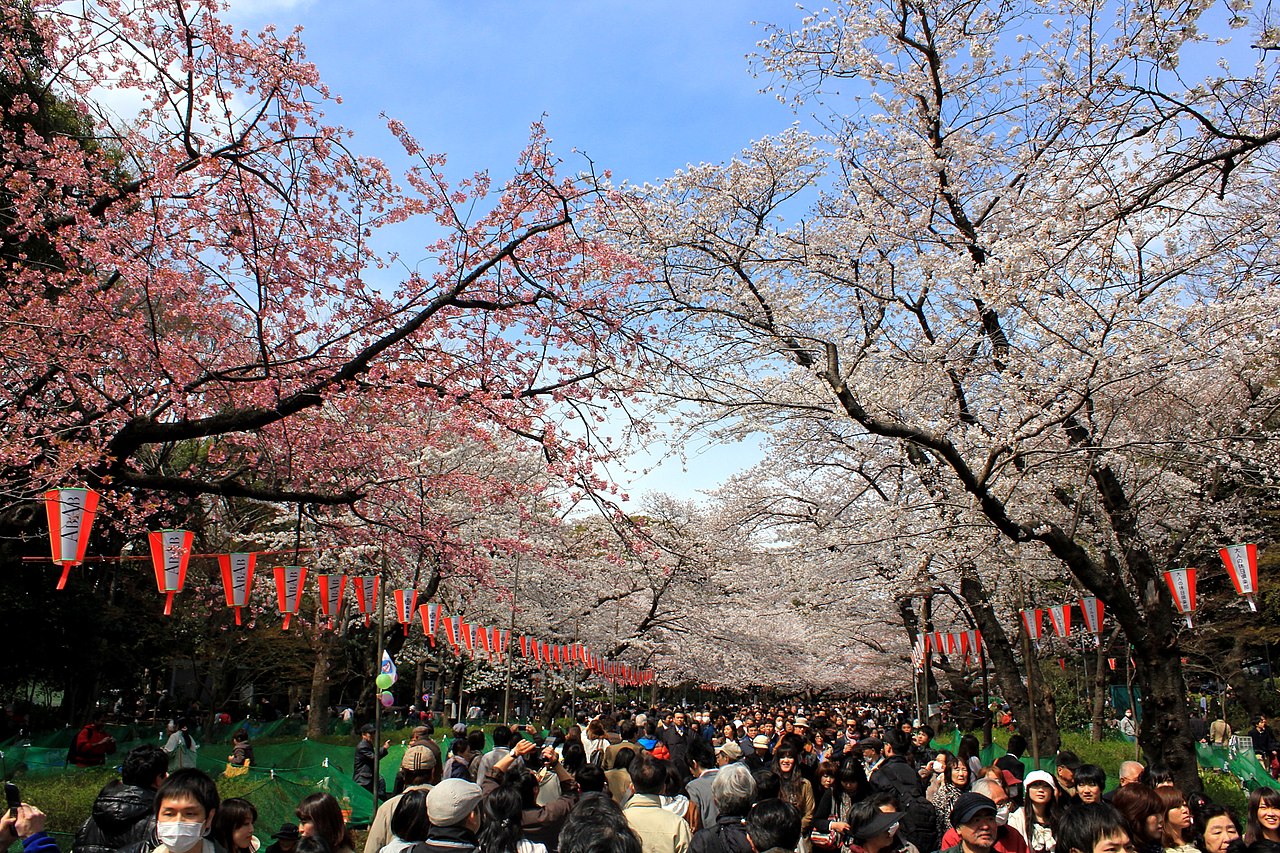
Hanami — cherry blossom viewing — in Ueno Park. Thousands gather here every April.
Is April a good time to visit Tokyo?
Yes — with one important caveat. Early to mid-April (1st–20th) is one of the best times of the year to visit Tokyo. Cherry blossoms are either at peak or just past, the temperatures are comfortable at 12–18°C, and the light is extraordinary. The city is busy but not overwhelmed.
Late April (20th onwards) is a different story. Golden Week — Japan's major national holiday cluster — begins on April 29th. From this point through May 5th, domestic Japanese tourism explodes. Hotels double in price, Shinkansen sell out weeks in advance, and popular spots like Asakusa and Shibuya Crossing become genuinely uncomfortably crowded. If you can avoid these dates entirely, do so. If you're already planning to be there, book everything months ahead and manage expectations.
Cherry blossom timing — when do they actually peak?
Tokyo's cherry blossoms (sakura) are one of the great natural spectacles of the calendar, but the timing varies year to year depending on winter temperatures. In Tokyo, peak bloom (mankai — when 80%+ of flowers are open) typically falls between late March and the first week of April. The full bloom window lasts roughly 7–10 days before petals begin to fall.
In 2026, Tokyo's cherry blossoms peaked in the first week of April. By mid-April, most of the famous spots have moved from full bloom to hanafubuki — the petal snowfall phase, where pink petals drift from the trees in the breeze. Many visitors find this stage just as beautiful as full bloom, and crowds are noticeably thinner.
By late April, most petals are gone and the trees are in full leaf — a lush, deep green. This is actually the beginning of what's called the fresh green season (shinryoku), which has its own quiet beauty and fewer tourists chasing it.
The Japan Meteorological Corporation publishes an official sakura forecast (桜開花予想) every year, usually from late January. Check japan-guide.com/sakura for English-language forecasts and real-time bloom reports from parks across Tokyo. This is the most reliable source — ignore travel blogs with generic "late March to April" dates that don't reflect the actual year.
April weather in Tokyo
April in Tokyo is genuinely pleasant — a significant improvement over the grey cold of February and March. Expect mild days and cool evenings. A light jacket is essential; a heavy coat is unnecessary from mid-April onwards.
What to wear: Layer up. Mornings and evenings drop to 8–10°C in early April. A light down jacket or wool cardigan over a t-shirt works well. By late April, a denim jacket or thin coat is enough. Comfortable walking shoes are non-negotiable — you'll cover 15,000–20,000 steps on active days.
Rain: April is one of Tokyo's rainier months. Carry a compact umbrella — convenience stores sell them everywhere for ¥500–800. A light rain shower during sakura season produces one of the most beautiful sights in the city: petals drifting down in wet air. It's not necessarily a bad thing.
Best cherry blossom spots in Tokyo

Shinjuku Gyoen — one of Tokyo's finest gardens and the best place to see multiple cherry varieties in bloom
Hanami — how cherry blossom viewing actually works
Hanami (花見, literally "flower viewing") is a centuries-old tradition that in modern Tokyo means gathering under cherry trees with food, drinks and friends. The ritual is straightforward but knowing the rules makes the experience much better.
The tarp: Groups arrive early — sometimes from 7am — to lay down a blue plastic sheet (available in any 100 yen shop or convenience store) to claim their spot. Arriving after 10am at popular parks on a weekend means finding whatever space remains. Weekday mornings are significantly less competitive.
The food: Onigiri, sandwiches, fried chicken, fruit — all from convenience stores works perfectly. Ueno has street food stalls during sakura season. Many restaurants near popular parks offer takeaway bento boxes. Cold beers and nihonshu (sake) are traditional.
The etiquette: Keep noise at a reasonable level, don't intrude on other groups' tarps, clean up all rubbish when you leave (bins are scarce — bring bags), and don't shake the trees or pull branches down for photos. The last one seems obvious; unfortunately it needs to be said.
Golden Week — the warning you must read
What it is: Japan's longest national holiday cluster, combining four public holidays. Virtually every working Japanese person takes time off. Domestic tourism peaks sharply.
What it means for you: Hotel prices increase 30–100%. Bullet trains sell out weeks in advance. Theme parks, aquariums, popular restaurants — all hit maximum capacity. Queues that are normally 20 minutes become 2 hours.
What to do: If visiting during Golden Week, book accommodation 6–8 weeks ahead, buy Shinkansen tickets immediately upon opening (exactly 1 month before travel date, at 10am Japan time). Avoid the most popular sites on weekend days — opt for early mornings, late evenings, and lesser-known neighbourhoods like Yanesen, Shimokitazawa or Koenji.
Silver lining: The energy of Tokyo during Golden Week is undeniably exciting. With good planning, it's a fantastic time to visit — just not an easy one.
Beyond sakura — what else to do in April

The Meguro River in Nakameguro — best in the city for cherry blossoms over water
Day trips: Nikko, Hakone, Kamakura
April is ideal for Tokyo's famous day trip destinations. Nikko in the mountains has its own cherry blossoms slightly later than the city, often peaking in mid-April. Kamakura is beautiful in spring with wisteria beginning to bloom at Tsurugaoka Hachimangu Shrine by late April. Hakone offers mountain air, onsen and clear views of Mount Fuji — April's blue skies make Fuji particularly visible before summer haze sets in.
Wisteria — the flower that follows sakura
As cherry blossoms fall in late April, wisteria (fuji) begins to bloom. Kameido Tenjin Shrine in eastern Tokyo and Kawachi Fuji Garden in Kitakyushu are famous for wisteria tunnels, but several spots within Tokyo itself offer remarkable displays at no cost. This is the hidden second act of spring that most first-time visitors miss entirely.
Sumo tournament
The Natsu Basho (Summer Tournament) doesn't start until May, but the Haru Basho in Osaka runs in March — if you're arriving in early April, check whether any tournaments are running at the Ryogoku Kokugikan (the main Tokyo sumo arena). Day tickets are available at the door from around ¥2,000. Watching sumo in its home setting, even without understanding the traditions, is an experience unlike anything else in sport.
April budget and booking tips
April is peak season. Hotel prices in central Tokyo (Shinjuku, Asakusa, Shibuya) are 20–40% higher than in February or November. The sweet spot for booking is 2–3 months ahead for the first three weeks of April; for Golden Week, 3–4 months is more realistic for good options.
Accommodation: Business hotels like Toyoko Inn and Dormy Inn remain relatively affordable even in peak season (¥8,000–12,000 per night). Capsule hotels and design hostels are particularly good value — rooms book out fast but prices are controlled. Ryokan with onsen become special in spring and are worth the splurge.
For finding the best rates, search Travala — they aggregate pricing across 2.5 million properties worldwide and often find deals that single OTAs miss.
Book accommodation at least 2 months ahead — earlier if Golden Week overlaps
Get a Suica card at the airport — essential for navigating all transport seamlessly
Download Google Maps offline for Tokyo before you fly
Pack layers — mornings are cool (8–10°C), afternoons warm (16–18°C)
Buy a compact umbrella in Tokyo for ¥500 from any convenience store
Check the bloom forecast at japan-guide.com/sakura before arrival
Avoid Golden Week days at the busiest spots unless you've booked far ahead